
 Entri Admin
Choosing which bank to open an account with is a very important decision. Many Entrepreneurs may end up choosing the same bank that they bank with personally, but this isn’t necessarily the best option. That’s because the needs of your business and your personal needs are very different. So, while it may be easier to transfer funds between your personal and business account, it won’t necessarily be the right choice in the long term. You need to consider which bank will cater to your business needs in the most cost-effective manner.
In this article we outline the three key points you should consider, when choosing a banking partner for a startup business. We also compare different banks and the packages they offer to Entrepreneurs.
It’s important to keep your personal and business affairs separate – and this separation should start with banking. Using your personal bank account for business is a big no-no, so when you start your new business, you should open up a separate bank account.
It is a dauting task comparing different institutions’ bank fees, so we’ve done it for you. The following table has the most basic and popular features most Entrepreneurs need to consider, when choosing a banking partner for their business. Below is a comparison of entry level packages available at each of these banks.
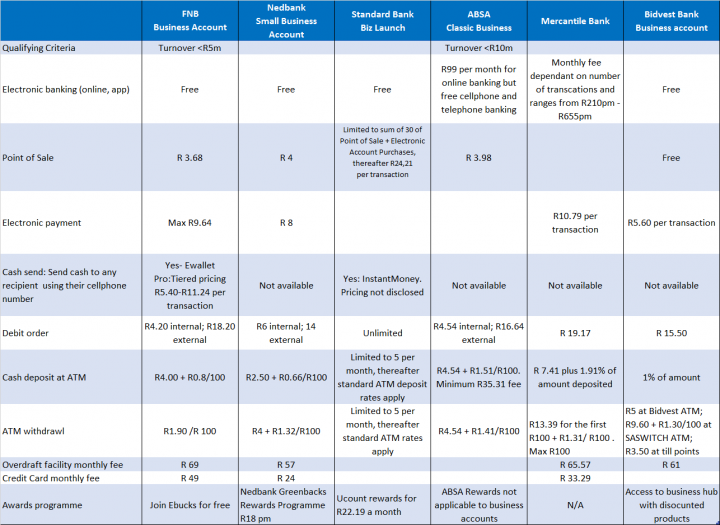
Based on 2018 pricing schedules
If you have a sole proprietorship, there are banking partners that offer the option of opening a cheaper personal bank account. However, you still need to keep your affairs separate. These go for as little as R4.50 a month from banks such as Old Mutual and Capitec.
We are keeping a close eye on the new upcoming banks in SA such as Bank Zero that has hinted at low fees for business accounts. We’ll keep you posted.
Price isn’t the only factor you should consider when choosing a banking partner. A bank’s service and value offerings can help your business run more efficiently, as well as saving you time and money. While these banks have a variety of value added offerings, we explored the common basic services we think most Entrepreneurs will find valuable.
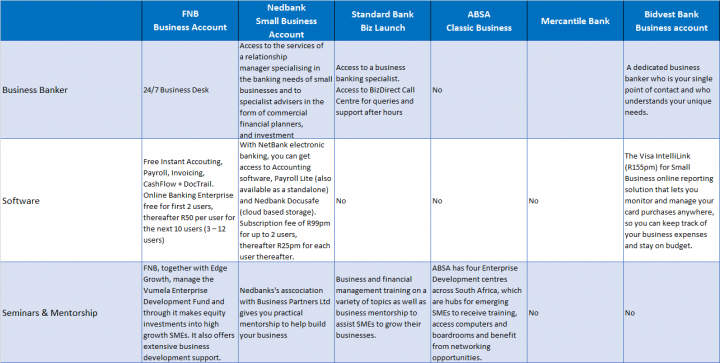
If you consider the entry level costs and value-added offerings at each bank, the following list is how we would rank the banking partners available to Entrepreneurs:
We were a bit torn between Bidvest and FNB business offering.
The biggest advantage that FNB offers is the free accounting, payroll and invoicing software. This simplifies the accounting challenges you face as an Entrepreneur. Instant Accounting will take all the transactions on your bank account and automatically prepare your monthly and annual financial statements for you. You can also choose to process entries manually. In addition, it allows you to set budgets and track your progress. Of course, cloud based accounting is not unique to FNB; Nedbank offers it, as well as a host of other providers, but they charge a monthly fee, unlike FNB. As Entrepreneur, these are unnecessary costs that you can do without. However, if you go with Bidvest, the savings on bank charges could be used to pay the R150pm for cloud accounting with SMEasy.
As an aside, FNB and Standard Bank can facilitate sending cash to employees or suppliers that do not have bank accounts, which could also prove a useful tool for some Entrepreneurs.
Remember that your choice will depend on your business needs, what sort of transactions you typically perform and how frequently you perform them. Perhaps you have hired an accountant or a bookkeeper, so FNB’s free accounting software is not an added advantage for your business. Or you may find that the entry level packages are not comprehensive enough for your business needs. In that case, you’ll have to compare the premium packages against your business’s needs, considering price, value and service.